Working on a full perimeter or a data center campus? Start at Crash Rated Perimeter, our site for complete anti-ram fence lines and layered vehicle barrier design.
ASTM F2656 rating plateMedium-duty truck (M) series
Test vehicle
15,000 lb (6,800 kg) medium-duty truck
Impact speed
50 mph (80 km/h)
Kinetic energy
≈ 1,690 kJ (1.25 million ft·lb)
Legacy DOS rating
K12
Typical use
Federal, DoD and critical-infrastructure entries with approach roads that allow highway speed
P1 ≤ 3.3 ft
P2 ≤ 23 ft
P3 ≤ 98 ft
P4 > 98 ft
Penetration is measured from the barrier's attack face to the leading edge of the truck bed. Most specifications require P1. The gate, posts, foundation and latching hardware are certified together as one system.
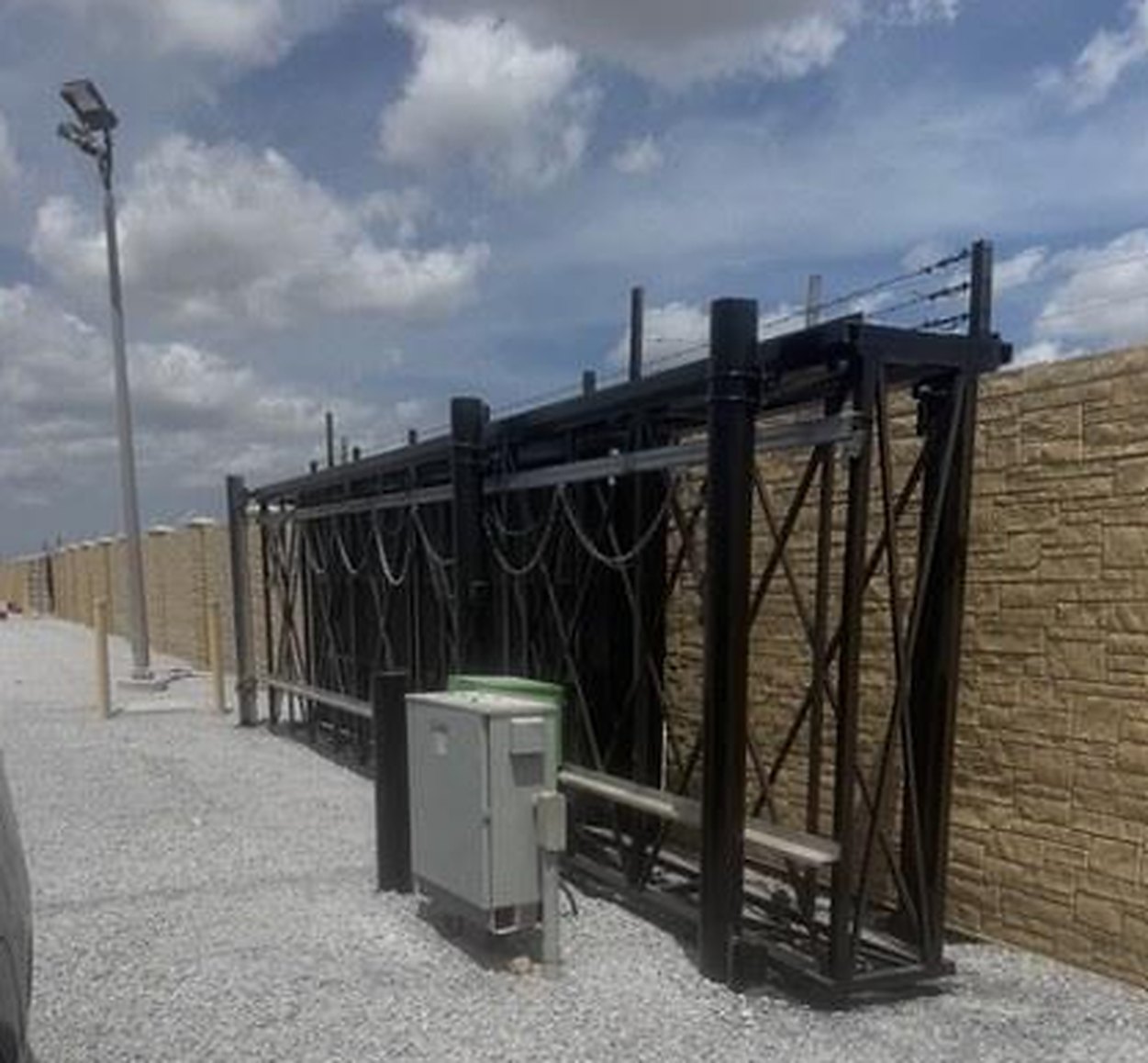
Box-framed cantilever gate, fabricated in Argyle and installed at a Texas substation. See how it is built below.
Crash ratings, explained without the sales language
Specifiers see M-ratings, K-ratings, C, PU and H designations, and penetration letters on the same drawing. This is how they fit together.
Impact simulator
Pick the vehicle and approach speed a spec is worried about. The truck runs at the barrier; the readout tells you the energy and whether the selected rating holds it to P1.
Kinetic energy1,690 kJ
Equivalent ASTM classM50
Legacy DOSK12
Selected gate resultStops at P1
ASTM F2656 vehicle classes and speeds with legacy Department of State equivalents
ASTM F2656
Test vehicle
Speed
Legacy DOS
Where it shows up
C40 / C50 / C60
Small passenger car, 2,430 lb
40 / 50 / 60 mph
—
Pedestrian plazas, storefronts, low-mass threats
PU40 / PU50 / PU60
Pickup truck, 5,070 lb
40 / 50 / 60 mph
—
Commercial campuses, parking structures
M30
Medium-duty truck, 15,000 lb
30 mph
K4
Substations, utility yards, secondary gates
M40
Medium-duty truck, 15,000 lb
40 mph
K8
Data center main entries, industrial plants
M50
Medium-duty truck, 15,000 lb
50 mph
K12
DoD, federal, long straight approach roads
H30 / H40 / H50
Heavy goods vehicle, 65,000 lb
30 / 40 / 50 mph
—
Highest-threat perimeters, port and airside
Penetration designations under F2656-20: P1 ≤ 1 m (3.3 ft), P2 1.01–7 m (3.3–23 ft), P3 7.01–30 m (23–98.4 ft), P4 greater than 30 m. Older F2656-07 reports use the same letters with slightly different breakpoints; check the certificate date.
How to read a spec that mixes standards
A drawing that calls out "K12/M50 P1" is asking for one thing: a system certified under ASTM F2656 to stop a 15,000 lb truck at 50 mph with less than a meter of bed penetration. The K-rating is included for reviewers who learned the older DOS scale.
If the spec references IWA 14-1 or PAS 68 (common on projects with international owners), the vehicle classes are similar but the certificates are not interchangeable. We flag this during design-assist so the submittal does not get rejected later.
Approach speed matters more than most owners expect. A gate at the end of a 600 ft straight road faces a different threat than one behind a serpentine chicane, and the rating, foundation cost and operator size all follow from that number.
The cornerstone gate: a box-framed cantilever, built in Argyle
This is a Trait gate at a Texas substation. Tap the markers to see what each part does under impact and under ten years of cycling.
Box truss frame
Two parallel planes of steel tied with diagonals instead of one flat panel. Impact load spreads through the whole leaf, so it resists bending and racking instead of folding at the first weld. The depth also carries heavy infill without sag over a long span.
Carrier and roller trucks
The leaf hangs from a top carrier on enclosed roller trucks, so nothing touches the ground. Gravel, ice and washout in the drive do not stop the gate, and the counterbalance section behind the posts keeps the leaf balanced through the full travel.
Gate operator
Industrial slide operator sized for leaf weight and duty cycle, with UL 325 entrapment protection, loop detection and access control integration. It is the part that gets serviced, which is why Gate Tech Pros handles maintenance after handover.
Posts and foundation
Heavy-wall posts on engineered reinforced-concrete footings. On a certified crash-rated system the foundation is tested as part of the barrier, and on this gate the posts are what turn an impact into a load the ground can take.
ArgyleTexas shop where the leaf was fabricated
0ground track to foul
1mobilization for gate, fence and operator
Crash-rated gate and barrier systems we design, fabricate and install
Every entry is a different combination of throughput, approach speed, soil, power and budget. These are the systems we build most.
Crash-rated cantilever slide gates
Track-free slide gates for openings from 20 to 60 feet, carried on a counterbalance section and heavy-duty roller trucks. The certified system includes the gate leaf, receiver post, roller post and the reinforced foundation between them. Cantilever is the default for substations and data centers because there is no ground track to foul with gravel, ice or debris.
Typical ratingM30 P1 through M50 P1. Operated by industrial slide operators sized for leaf weight and cycle count.
Crash-rated swing gates
Single- and bi-parting swing gates with reinforced hinge posts and a crash beam or cable catch at the latch side. Swing gates suit narrower openings, limited lateral run-back, and sites that need a manual fail-secure option. Heavy hinge assemblies and deep hinge-post foundations take the impact load.
Typical ratingM30 P1 and M50 P1 in openings to roughly 30 ft. Manual, hydraulic or electromechanical operation.
Box-framed industrial gates
Our own fabrication: a three-dimensional box truss frame instead of a single-plane panel, so the leaf resists bending and racking under impact and under years of cycling. Box framing lets us carry heavier infill (expanded metal, welded wire, anti-climb mesh, ballistic panels) without deflection. Used where a certified crash rating is not mandated but the owner wants a leaf that behaves like one.
Fixed, removable and retractable bollards for pedestrian-adjacent entries, guardhouses and the ends of fence lines where a gate cannot go. Shallow-mount foundations (as little as 10 to 14 inches) are available for sites with utilities, rooftop decks or post-tensioned slabs. Bollards also fill the gap that a slide gate leaves open while it cycles.
Typical ratingM30 through M50 P1, single or arrayed at 3 to 5 ft clear spacing.
Crash-rated beam and drop-arm barriers
Beam barriers and drop arms open in three to six seconds, which is why they carry the traffic at guarded entries while a slower slide gate secures the perimeter after hours. Hydraulic or electromechanical drives, EFO (emergency fast operate) capability, and integration with the guard booth's control panel.
Typical ratingM30 P1 to M50 P1 in clear openings to about 24 ft.
Anti-ram crash-rated fence
Cable-reinforced and post-and-rail fence lines certified as a run, not just at the gate. Anti-ram fence keeps a vehicle from simply driving around the gate, and it is now specified on most new data center campuses and CIP-014 substations. We install it in the same mobilization as the gate so foundations, alignment and grounding are coordinated once. Full fence-line design lives at crashratedperimeter.com.
Typical ratingM30 P1 and M50 P1 with 8 to 12 ft post spacing, anti-climb fabric optional.
Gate automation and access control
Industrial operators, UL 325 entrapment protection, loop detectors, card and LPR readers, intercoms and integration with the site's access control platform. Crash-rated gates are heavy and cycle hard, so operator sizing and maintenance intervals are part of the design, not an afterthought. Ongoing service in Texas is handled by our gate technicians at Gate Tech Pros.
The rating usually comes from a standard the owner is bound to. Knowing which one saves a round of submittals.
Electric substations and utility yards
Transmission stations designated under CIP-014 need documented physical security plans, and crash-rated gates and anti-ram fence are the visible part of that plan. We work under utility safety programs and around energized equipment.
NERC CIP-014 / IEEE 1402
Data centers
Hyperscale and colocation owners specify M30 to M50 gates, beam barriers at guardhouses and anti-ram fence around the full campus. Schedules are compressed and the perimeter is usually on the critical path for commissioning.
Owner security standards / ASTM F2656 M30–M50
Federal, GSA and DoD facilities
Vehicle barriers selected under Unified Facilities Criteria, delivered with certified test reports, foundation drawings and O&M documentation. Trait performs perimeter security work as a subcontractor on federal task orders.
UFC 4-022-02 / UFC 4-022-03 / ISC RMP
Industrial, chemical and water
Refineries, pipeline compressor stations, chemical plants under CFATS-style programs, and water and wastewater plants that need to control vehicle approach without stopping tanker traffic.
Facility security plans / AWIA risk assessments
How a crash-rated gate project runs with Trait
One contractor from the first budget number through the operator's first service visit.
Design-assist and budgeting
We read the security narrative and drawings, confirm the rating and standard, check approach speed and run-back space, and return a budget with the foundation scope called out separately.
Engineering and submittals
Certified test reports, manufacturer foundation details adapted to your geotechnical report, stamped drawings where required, and electrical and controls coordination.
Fabrication
Box-framed leaves, posts, catch assemblies and fence components fabricated in our Argyle, Texas shop. Hot-dip galvanized or powder-coated per spec.
Foundations and installation
Our crews set rebar and pour footings, erect posts, hang and align gates, and install fence lines in a single mobilization wherever the site allows.
Automation and commissioning
Operators, safety devices and access control installed, tested and documented. Guard staff walked through daily and emergency operation.
Service
Preventive maintenance and repair through Gate Tech Pros so a heavy leaf keeps cycling on schedule for the life of the site.
Questions we answer on most bids
Short answers. Call for the long ones.
What does a crash rating like M50 or K12 mean?
Under ASTM F2656, an M-rating describes a 15,000 lb medium-duty truck impact at 30, 40 or 50 mph (M30, M40, M50). The older Department of State K4, K8 and K12 ratings map to roughly the same three speeds. The rating is paired with a penetration designation, P1 through P4, that describes how far the truck bed travels past the barrier. Most specifications require P1.
Is a crash-rated gate the same as a heavy-duty industrial gate?
No. A crash-rated gate is a tested system: the leaf, posts, catch, foundation and, on slide gates, the roller and latch assembly were impacted together at a test facility and achieved a rating. A heavy-duty gate built to look similar has no verified stopping performance. Our box-framed gates fill the middle ground for owners who want a much stronger leaf without a certified rating.
Do crash-rated gates require special foundations?
Yes. The foundation is part of the certified system, and most M30 through M50 gates need engineered reinforced-concrete footings. Soil conditions can change the design. We coordinate geotechnical data, foundation drawings and rebar with the manufacturer's certified details, and we pour the foundations ourselves.
How long does a crash-rated gate take to deliver and install?
Certified gate systems typically run 10 to 16 weeks from approved submittals, with bollards and beam barriers often faster. Foundations can be poured while the gate is in fabrication. Our own box-framed gates and fence are on a shorter shop schedule.
What is the difference between ASTM F2656 and IWA 14-1 or PAS 68?
ASTM F2656 is the U.S. standard most federal, utility and data center specifications reference. IWA 14-1 and the UK's PAS 68 are the international equivalents. Ratings are broadly comparable but not interchangeable, so the specification should state which standard governs.
Where do you work?
Trait is based in Argyle, Texas, and self-performs across Texas and neighboring states. For larger perimeters and out-of-region projects we mobilize nationally with partner firms; see traitllc.com for the full service area and other trades.
The Trait family of perimeter security sites
CrashRatedGate.com covers the gate and barrier. These sister sites cover the rest of the perimeter and everything after installation.
Send the drawings or the security narrative and we will come back with a rating recommendation and a number. Prefer a longer form or a map? Use the contact page.